Cutting of Fiber-reinforced Plastics
Futonics thulium fiber lasers are suitable for the precise and wear-free cutting of fiber-reinforced plastics. Due to their high beam quality and tightly focusable laser power, complex contours, fine cutting geometries and demanding component shapes in composite materials can be processed efficiently.
Fiber-reinforced plastics, also known as FRP, consist of a polymer matrix reinforced with glass, carbon or other fibers. Important material groups include glass fiber-reinforced plastics, GFRP, and carbon fiber-reinforced plastics, CFRP. These composite materials offer high strength at low weight and are widely used in lightweight construction, for example in the automotive industry, aerospace, medical technology, mechanical engineering, shipbuilding and technical structural components.
Advantages of laser cutting over mechanical processing
Mechanical processing of FRP, GFRP and CFRP is often associated with high tool wear. Cutting tools, milling cutters and drills are heavily stressed by abrasive fibers, which can lead to short tool life, high tooling costs and additional maintenance. Mechanical processes may also cause delamination, fraying or mechanical stress at the cut edge.
Laser cutting of fiber-reinforced plastics offers a contact-free and wear-free alternative. Since no mechanical tool comes into contact with the material, there is no tool wear and no mechanical stress on the component. Futonics fiber lasers enable precise cuts, reproducible processing results and economical integration into industrial manufacturing processes.
Why thulium fiber lasers are suitable for composite materials
Composite materials place high demands on the cutting process because fibers and polymer matrix have different absorption and thermal conduction properties. Controlled energy delivery is therefore particularly important. Futonics thulium fiber lasers in the 2 µm wavelength range offer a combination of high beam quality, stable output power and precise focusability.
The high power density in the focus enables the cutting of complex shapes and contours in fiber-reinforced plastics. At the same time, contact-free processing supports high process stability and reduces the influence of tool wear, material contact and mechanical stress.
Typical applications
- Cutting of fiber-reinforced plastics
- Processing of CFRP and GFRP components
- Contour cutting of complex composite shapes
- Cutting of technical lightweight components
- Processing of thermoplastic and thermoset composite materials
- Cutting of structural components for automotive and aerospace applications
- Integration into automated cutting and manufacturing systems
- Precision processing of industrial polymer composites
Advantages of cutting fiber-reinforced plastics with Futonics lasers
- Precise cutting of complex contours and geometries
- Contact-free processing without mechanical stress on the component
- Wear-free process without cutting tools, milling cutters or drills
- Economical alternative to conventional machining processes
- Reduced maintenance due to eliminated tool wear
- Suitable for GFRP, CFRP and other fiber-reinforced plastics
- High beam quality for narrow and reproducible cutting lines
- Easy integration into industrial systems and OEM platforms
- Suitable for automated manufacturing processes in lightweight construction
Industrial processing of composite materials
Futonics fiber lasers have already been used as laser sources for the processing of composite materials, including projects with industrial partners such as Durmazlar Makina. These applications demonstrate the potential of thulium fiber lasers for precise processing of modern lightweight materials in industrial manufacturing environments.
Technical consulting for laser cutting of FRP, GFRP and CFRP
Whether a fiber-reinforced plastic can be cut with a thulium fiber laser depends on material structure, fiber type, matrix material, component thickness, cutting geometry and process requirements. Futonics supports you in evaluating your application and selecting a suitable laser module for laboratory, industrial or OEM systems.
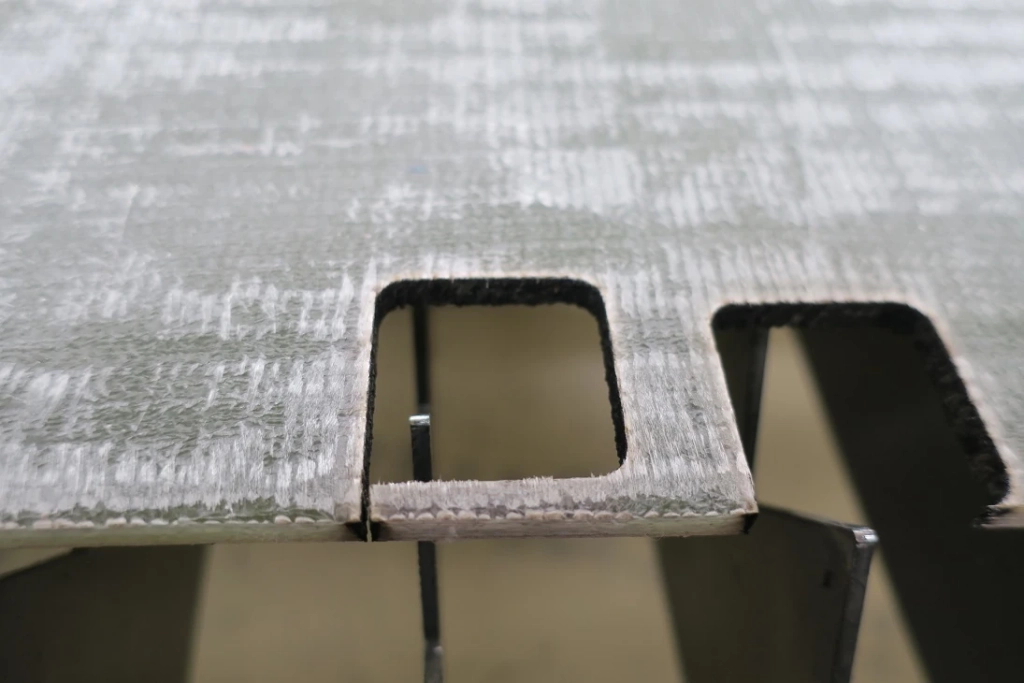
Shown below is a collaboration with Durmazlar Makina.
The pictures show the cutting process of E-glass. Other similar materials have been successfully cut by Futonics fiber laser systems.
Recommended Laser
400 W Thulium Fiber Laser
- Up to 400 W continuous power
- 2 µm wavelength range
- Excellent beam quality
- Reliable industrial operation