Cutting of Laminated-Glass
Futonics thulium fiber lasers are suitable for precise cutting of the plastic interlayer in laminated safety glass. In combination with conventional glass cutting methods, such as diamond cutting or scoring and breaking, laminated glass can be processed automatically along both straight lines and contoured shapes.
Laminated safety glass consists of multiple glass layers bonded together by a polymer film. This interlayer is often made of PVB, EVA or similar plastics. While the glass layers can be separated using conventional glass cutting tools, the plastic film presents a particular challenge when cutting laminated glass. Futonics lasers enable this polymer interlayer to be cut selectively and contact-free through the glass.

Challenge of conventional laminated safety glass cutting
In conventional processes, laminated safety glass is first scored and broken. The cutting area is then often heated with infrared radiation to soften the plastic film between the glass layers. The film is subsequently separated by pulling the cut glass sections apart or by using additional cutting tools.
In many cases, this process is limited to straight cutting lines. Contoured cuts, complex geometries or automated free-form processing are only possible to a limited extent. In addition, mechanical separation of the plastic interlayer can lead to unwanted changes at the cut edges.
Advantages of laser cutting the plastic interlayer
Mechanical separation of the polymer film can cause jagged edges, uneven film borders or small gaps between the glass layers. If the film is separated by pulling the glass parts apart, the plastic layer can be partially pulled out of the edge area. This can result in uneven edges that may require further post-processing.
Laser cutting of the plastic film with Futonics thulium fiber lasers provides a precise alternative. Due to the suitable absorption of 2 µm laser radiation in many plastics, the polymer interlayer can be selectively separated through the glass. Infrared heating is no longer required, and the plastic layer can be processed in a controlled manner along the desired cutting contour.
Why 2 µm thulium fiber lasers are suitable for laminated glass
Futonics thulium fiber lasers emit in the 2 µm wavelength range. This wavelength is more strongly absorbed by many polymer materials than by glass. As a result, the laser energy can be selectively introduced into the plastic interlayer, while the glass layers continue to be processed with proven glass cutting tools.
The combination of conventional glass cutting and laser-based film separation enables precise cut edges, clean separation of the polymer layer and improved process automation. Especially for contoured shapes, this method opens up new possibilities for processing laminated safety glass.
Typical applications
- Cutting of laminated safety glass
- Separation of the plastic film between glass layers
- Contour cutting of laminated glass
- Automated processing of laminated glass
- Combination of diamond cutting and laser cutting
- Processing of PVB, EVA or similar polymer interlayers
- Cutting of technical glass-polymer composite structures
- Precision glass processing for architecture, automotive applications and industry
Advantages of cutting laminated safety glass with Futonics lasers
- Precise cutting of the plastic interlayer in laminated glass
- Suitable for straight and contoured cutting lines
- No additional infrared heating required
- Contact-free separation of the polymer film
- Clean cut edges on both glass and plastic layers
- Reduction of jagged film edges and edge defects
- Improved automation compared with purely mechanical processes
- Can be combined with conventional glass cutting tools
- New possibilities for complex shapes and free-form cuts
- Easy integration into industrial glass processing systems and OEM platforms
Technical consulting for cutting laminated safety glass
Whether laminated safety glass can be processed with a Futonics thulium fiber laser depends on the glass structure, film material, layer thickness, cutting geometry, process speed and system concept. Futonics supports you in evaluating your application and selecting a suitable laser module for automated glass processing, industrial cutting systems or OEM platforms.
In a collaboration between Futonics Laser GmbH and HEGLA GmbH & Co. KG, the world’s first contoured laminated glass cutting machine has been developed. It was demonstrated at the Glasstec international trade fair in 2016 and 2018.
Images and videos were kindly provided by HEGLA GmbH & Co. KG.
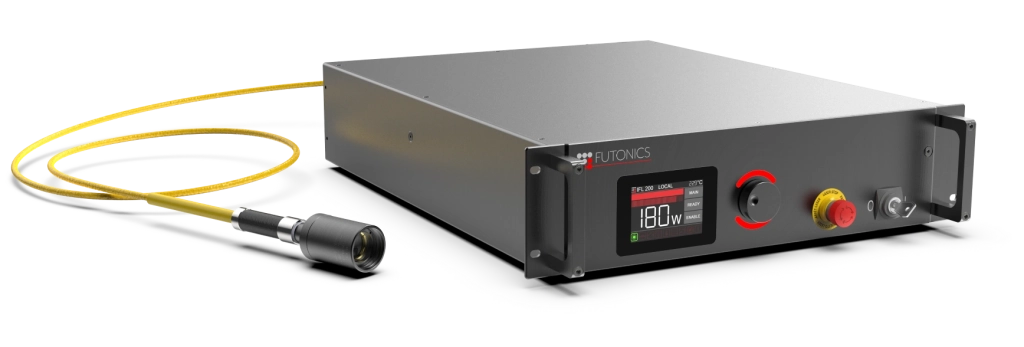
Recommended Laser
400 W Thulium Fiber Laser
- Up to 400 W continuous power
- 2 µm wavelength range
- Excellent beam quality
- Reliable industrial operation