Marking of Metals
Futonics fiber lasers are well-suited for processing a variety of metals due to their absorption properties Futonics thulium fiber lasers are suitable for precise marking and engraving of various metals and metal alloys. Due to their high beam quality and controlled energy delivery, permanent markings with high detail accuracy, good readability and reproducible quality can be created.
Laser marking of metals is performed contact-free and without mechanical tools. This makes the process particularly suitable for industrial applications where components need to be permanently marked, made traceable or provided with technical information. Typical markings include serial numbers, product data, logos, text, Data Matrix codes, QR codes and functional markings.

Suitable metals and surfaces
Futonics lasers can be used for a wide range of metallic materials. These include soft metals such as aluminum as well as stainless steel, steel, metal alloys and coated metals. Materials such as copper, brass, silver and gold can also be marked or engraved depending on the surface, alloy and process parameters.
Typical materials:
- Aluminum
- Stainless steel
- Steel
- Metal alloys
- Copper
- Brass
- Silver
- Gold
- Coated metals
Advantages of laser marking compared with conventional methods
In many industries, metal components are marked using labels, printing processes, mechanical engraving or embossing. These methods can require additional materials, cause tool wear or apply mechanical stress to the component. Labels can detach, printed markings can fade and mechanical processes can damage sensitive parts.
Laser marking and laser engraving of metals provide a permanent, contact-free and wear-free alternative. Markings are created directly on the metal surface and remain clearly readable even under high stress. This makes the process particularly suitable for traceability, quality assurance and industrial series production.
Annealing and engraving of metals
For certain metals, especially stainless steel, controlled heat input can create a dark oxide layer. This annealing process enables high-contrast markings without significant material removal. Alternatively, metals can be processed by laser engraving with material removal when a recessed or particularly robust marking is required.
Depending on the material, surface and desired result, Futonics lasers can be used for different marking processes, including annealing, engraving, structuring and the generation of high-resolution codes or technical labels.
Typical applications
- Product marking on metal components
- Serial numbers and batch numbers
- Data Matrix codes and QR codes for traceability
- Logos, text, images and technical symbols
- Functional markings on tools
- Metal tags and nameplates
- Marking of electrical and electronic components
- Labeling of automotive, aerospace and mechanical engineering components
- Marking of stainless steel, aluminum and metal alloys
- Industrial component traceability and quality assurance
Advantages of marking and engraving metals with Futonics lasers
- Permanent and clearly readable metal markings
- Contact-free process without mechanical stress on the component
- No mechanical engraving tool and no tool wear
- No inks, labels or additional consumables required
- High detail accuracy for codes, logos, text and symbols
- Suitable for aluminum, stainless steel, steel, alloys and coated metals
- Precise and clean metal processing
- Reproducible results for industrial series processes
- Easy integration into industrial systems and OEM platforms
Industries and fields of application
Laser marking of metals is used in many industries, especially where products and components must be permanently identifiable and traceable. Typical sectors include electrical engineering, electronics, mechanical engineering, tool manufacturing, automotive, aerospace, medical technology, jewelry manufacturing and industrial production.
Technical consulting for metal marking
Whether a metal can be marked or engraved with a Futonics thulium fiber laser depends on the material, alloy, surface coating, desired contrast, marking depth, processing speed and geometry. Futonics supports you in evaluating your application and selecting a suitable laser module for laboratory, industrial or OEM systems.
Here the serial number of the F-TO 175/2000 is engraved on anodized aluminum using an IFL30.
Recommended Laser
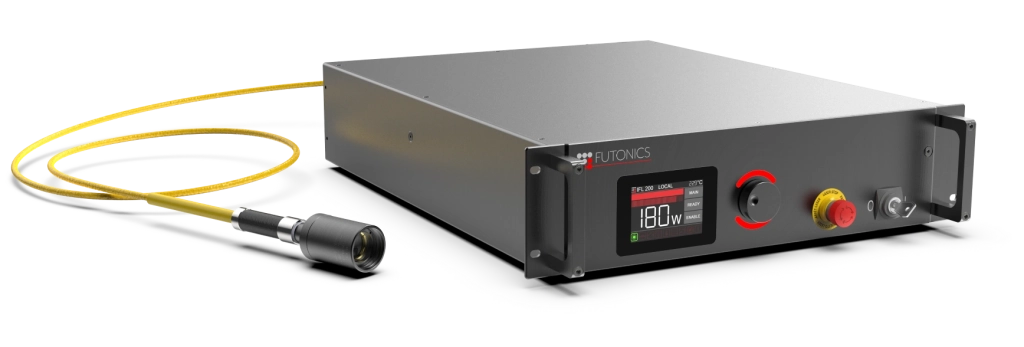
400 W Thulium Fiber Laser
- Up to 400 W continuous power
- 2 µm wavelength range
- Excellent beam quality
- Reliable industrial operation