How does a Thulium Fiber Laser work?
A thulium fiber laser is a solid-state laser in which active amplification does not take place in a crystal or gas medium, but inside an optical fiber. This fiber is doped with thulium ions. When the fiber is excited with pump light, the thulium ions can generate laser radiation in the range of approximately 2 µm. This wavelength range is particularly interesting for many industrial, medical, and scientific applications because it differs significantly from the widely used 1 µm fiber lasers.
Futonics develops thulium fiber lasers as high-power oscillator systems. This means that the laser power is generated directly inside the resonator, without requiring downstream power amplifiers. This approach differs fundamentally from conventional MOPA lasers, meaning Master Oscillator Power Amplifier systems. Especially in the 2 µm range, the direct high-power oscillator offers decisive advantages in terms of robustness, efficiency, thermal stability, and system reliability.
Basic Principle of a Thulium Fiber Laser
The core of a thulium fiber laser is a thulium-doped active glass fiber. This fiber is optically excited by pump diodes. The supplied pump energy raises the thulium ions into an excited state. When they return to a lower energy state, laser light is generated in the 2 µm spectral range.
To turn this optical amplification into a stable laser beam, an optical resonator is created. In a fiber laser, this typically consists of the active fiber, fiber Bragg gratings, pump combiners, and a defined output. The fiber Bragg gratings act as mirrors within the fiber system and play a key role in determining the wavelength and stability of the laser.
A major advantage of modern fiber lasers is that the entire setup can be implemented monolithically. This means that the optical components are directly connected in a fiber-based architecture. As a result, there are fewer free-space beam paths, less alignment effort, and higher mechanical stability.

Why Is the 2 µm Wavelength Range Particularly Relevant?
Thulium fiber lasers typically operate in a wavelength range around 2 µm. This range is attractive for many applications because different materials show different absorption behavior at this wavelength than at 1 µm. These include plastics, organic materials, water-containing media, and certain types of medical tissue.
In materials processing, the 2 µm wavelength can also offer advantages. Depending on the material, it can enable more efficient energy coupling, more precise processing, or improved process control. This wavelength range is also particularly interesting for applications that require high beam quality, high power, and stable operating conditions at the same time.
At the same time, the technical implementation of high-power 2 µm fiber lasers is demanding. Components such as isolators, amplifier stages, and thermally loaded parts are often more difficult to realize in this spectral range than in established 1 µm systems. This is precisely where the high-power oscillator demonstrates its strengths.
Oscillator Instead of MOPA: What Is the Difference?
In a conventional MOPA laser, a so-called seed laser first generates a weak output signal. This signal is then brought to the required power level through one or more amplifier stages. MOPA stands for Master Oscillator Power Amplifier.
A high-power oscillator works differently. Here, the high output power is generated directly inside the laser resonator. There is no separate seed stage and no downstream power amplifier. This makes the optical setup significantly simpler.
A MOPA system can offer advantages in certain applications, for example when extremely flexible pulse shapes, ultrashort pulses, or highly specific electronic modulation are required. For robust high-power applications in the 2 µm range, however, a directly powerful oscillator is often the more convincing architecture. This is especially true when reliability, efficiency, beam quality, and industrial stability are the main priorities.
Advantages of a Thulium High-Power Oscillator
One of the main advantages of the oscillator concept is its high robustness against back reflections. Back reflections can occur when processing highly reflective materials and can cause instabilities or damage in sensitive laser systems. MOPA systems are particularly vulnerable in this respect because the power amplifier can react sensitively to back reflections, ASE, and parasitic oscillations. A single high-power oscillator does not require a sensitive seed component or multi-stage amplification, which makes the system architecture more robust.
The optical setup is also significantly simpler. While a MOPA system typically consists of a seed laser, pre-amplifier, power amplifier, isolators, ASE management, and complex gain control, an oscillator can be built fully monolithically from active fiber, fiber Bragg gratings, pump combiner, and output. Fewer components mean fewer potential failure sources, a lower probability of failure, and simpler production.
In addition, a direct high-power oscillator can achieve high efficiency. MOPA systems lose power through additional couplers, isolators, intermediate stages, and measures for ASE suppression. An oscillator avoids many of these internal loss sources. This is particularly relevant for thulium lasers, since thermal management in the 2 µm range can be demanding.
Another advantage is thermal stability. A MOPA system distributes optical power across multiple stages, each of which can have its own thermal loads and drift behavior. A single oscillator has fewer thermally critical areas, less gain drift, and fewer potential hot spots. This supports stable continuous operation.
Futonics FBG Technology for High-Power Oscillators
A central requirement for powerful thulium oscillators is the stability of the fiber Bragg gratings used in the resonator. In a fiber laser, FBGs act as precise resonator mirrors. They define the optical feedback conditions and contribute significantly to wavelength stability and beam quality.
At very high optical powers, however, FBGs can become a critical component. Even small absorption losses or material inhomogeneities can cause local heating. This can change the Bragg wavelength, the resonator stability, and the long-term reliability of the laser system.
Futonics has therefore developed its own FBG process, specifically designed for use in high-power oscillators. The fiber Bragg gratings produced with this process show no measurable heating even at very high laser powers. As a result, the resonator conditions remain stable even during continuous high-power operation.
This proprietary FBG technology is a key reason why Futonics can realize powerful monolithic thulium oscillators. Thermally stable FBGs enable high power, stable wavelength, excellent beam quality, and high long-term reliability.
By controlling its own FBG process, Futonics can optimize the resonator specifically for high powers in the 2 µm range. This enables compact, robust, and efficient fiber laser systems that clearly differ from conventional MOPA architectures.
Control of Nonlinear Effects at High Power
At high powers and high peak powers, nonlinear effects occur in fiber lasers. These include SBS, meaning Stimulated Brillouin Scattering, SRS, meaning Stimulated Raman Scattering, and self-phase modulation. These effects can limit power scaling, beam quality, and spectral stability.
MOPA amplifiers are particularly susceptible to such effects at high peak powers because the signal is strongly amplified in the amplifier stages. In an oscillator, the resonator design can be used to control nonlinear effects more effectively. This is especially relevant for narrow-linewidth lasers, single-mode systems, and long active fibers.
For industrial high-power applications, this stability is an important factor. A laser must not only reach a specific output power, but must also deliver this power reproducibly, controllably, and with high beam quality.
High Beam Quality at High Output Power
A well-designed single-mode thulium oscillator can combine high output power with very good beam quality. A low M² value, stable polarization, and a controlled spectrum are decisive for precise applications in materials processing, medical technology, and research.
Genuine high-power single-mode oscillators in the 2 µm range are technologically demanding. Power levels such as 200 W or 400 W in continuous-wave operation, while maintaining high beam quality, are not trivial and require a mature design of the entire fiber resonator.
The advantage of such an oscillator is that high power does not first have to be generated through additional amplifier stages. This reduces system complexity while improving optical stability and reliability.
Why Futonics Relies on High-Power Oscillators
Futonics follows an approach for thulium fiber lasers that is based on high-power oscillators. This architecture is particularly suitable for applications requiring robust, efficient, and industrial-grade laser systems.
A decisive advantage lies in the ability to design critical resonator components for the highest power ranges. Through its proprietary FBG process, Futonics can manufacture fiber Bragg gratings that remain thermally stable even at very high powers and show no measurable heating. As a result, the oscillator is not limited by thermal effects in the FBGs.
Compared with MOPA systems, the oscillator approach offers several systemic advantages:
- It requires fewer optical components.
- It avoids sensitive seed and amplifier stages.
- It is more robust against back reflections.
- It reduces internal loss sources.
- It offers high thermal stability.
- It enables high beam quality at high power.
- It is particularly suitable for demanding applications in the 2 µm wavelength range.
This allows Futonics thulium fiber lasers to stand apart technologically from many competing MOPA systems. While MOPA lasers are particularly strong when maximum pulse-shape flexibility or ultrashort pulses are required, the high-power oscillator offers a robust, efficient, and powerful solution for 2 µm laser systems.
Futonics generates high output powers directly inside the oscillator instead of subsequently amplifying a weak seed signal. This is made possible by a precisely designed monolithic fiber architecture and thermally stable high-power FBGs that operate reliably even under demanding operating conditions.
Typical Applications of Thulium Fiber Lasers
Thulium fiber lasers are used wherever the 2 µm wavelength range offers specific advantages. These include:
- Materials processing of metals and reflective targets
- Processing of transparent or specialized plastics
- Medical and biophotonic applications
- Research and development
- Spectroscopy
- High-power applications with high beam quality
Especially when processing reflective materials and sensitive workpieces, a robust laser architecture is essential. Back reflections, thermal drift, and unstable amplifier conditions can impair process reliability. A monolithic high-power oscillator provides a stable technical foundation here.
Summary
A thulium fiber laser generates laser radiation in the range of approximately 2 µm using a thulium-doped active fiber. This wavelength is particularly interesting for industrial, medical, and scientific applications.
Futonics uses high-power oscillators for its thulium fiber lasers instead of conventional MOPA architectures. The direct oscillator design reduces the number of optical components, improves robustness against back reflections, lowers internal losses, and supports thermally stable operation. Especially in the demanding 2 µm range, this architecture is a decisive advantage.
As a result, Futonics thulium fiber lasers provide a powerful platform for applications where high output power, very good beam quality, and industrial reliability are key requirements.
Below you will find links to our lasers and applications:
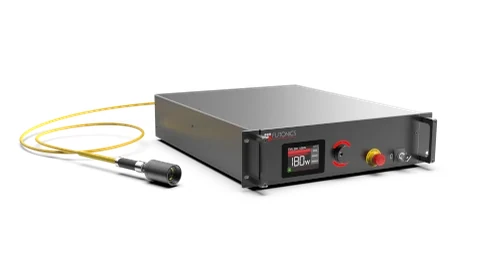
Thulium fiber lasers
Thulium fiber lasers in the 2 µm wavelength range for industrial, medical and scientific applications.
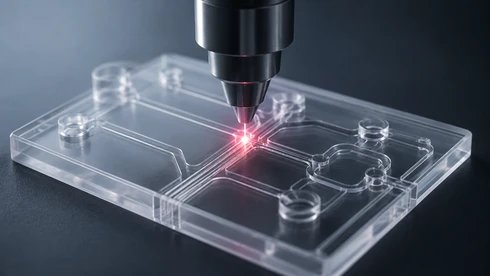
Applications
Industrial, medical and scientific applications of thulium fiber lasers.