Welding of Polymers
Futonics thulium fiber lasers enable precise laser welding of transparent and opaque thermoplastic polymers in the 2 µm wavelength range. Due to the intrinsic absorption of the laser radiation in many plastics, the welding process can be carried out without additional absorbers, pigments or additives. This results in clean, reproducible joints with high process control and locally confined heat input.
The process is particularly suitable for applications where optical quality, precise joining contours and contact-free processing are essential. Typical areas of application include technical plastic components, microfluidic structures, medical components, transparent housings, sensors and precise polymer joints in industrial manufacturing processes.
Why 2 µm lasers are suitable for plastic welding
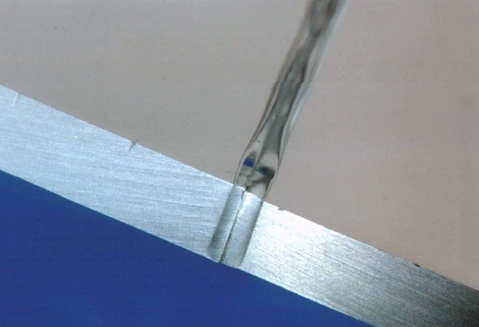
In laser welding of plastics, process quality strongly depends on absorption, penetration depth and beam quality. CO₂ lasers enable high processing speeds, but often have limited penetration depth and are mainly suitable for thin plastic films or surface-near processes. Diode and Nd:YAG lasers are frequently used for absorbing or additive-containing materials.
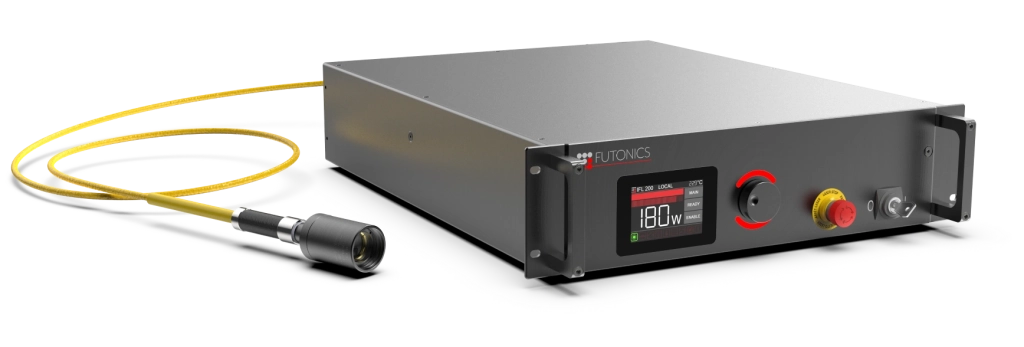
Thulium fiber lasers in the 2 µm wavelength range combine high beam quality, precise energy delivery and absorption characteristics suitable for many polymers. This enables transparent and colored thermoplastic materials to be welded efficiently and with a high degree of control. With output powers of up to 400 W and excellent single-mode beam quality, Futonics thulium fiber lasers are particularly well suited for demanding polymer welding processes that require precise energy delivery, high process stability and reproducible weld seams. The systems also provide stable output performance and a compact design for integration into industrial and OEM laser systems.
You can find out more about welding polymers using our lasers in the article “Welding of transparent and opaque polymers with single-mode Tm-doped fiber lasers“.
Advantages of polymer welding with Futonics thulium fiber lasers
- Precise laser welding of transparent and opaque polymers
- Contact-free process without mechanical stress on the components
- No additional absorbers, pigments or additives required
- Clean surfaces without visible marking when suitable process parameters are used
- Suitable for butt joints and defined joining geometries
- Locally confined heat input and high process control
- High beam quality for reproducible weld seams
- Low energy consumption compared with many conventional joining methods
- Easy integration into industrial systems and OEM platforms
Suitable applications
Futonics thulium fiber lasers are suitable for a wide range of plastic and polymer processing applications. These include welding transparent plastic sheets, joining microfluidic structures, welding technical plastic housings, joining medical polymer components and precision joining processes in sensors, diagnostics and industrial manufacturing.
Technical consulting for plastic welding
Whether a polymer can be welded with a 2 µm thulium fiber laser depends on the material, component geometry, weld seam design, wall thickness and process requirements. Futonics supports you in evaluating your application and selecting a suitable laser module for laboratory, industrial or OEM systems.
Recommended Laser
400 W Thulium Fiber Laser
- Up to 400 W continuous power
- 2 µm wavelength range
- Excellent beam quality
- Reliable industrial operation